Stoic Backgammon
A Profitable Pastime

An obsidian board in the void, one checker balanced on its edge.
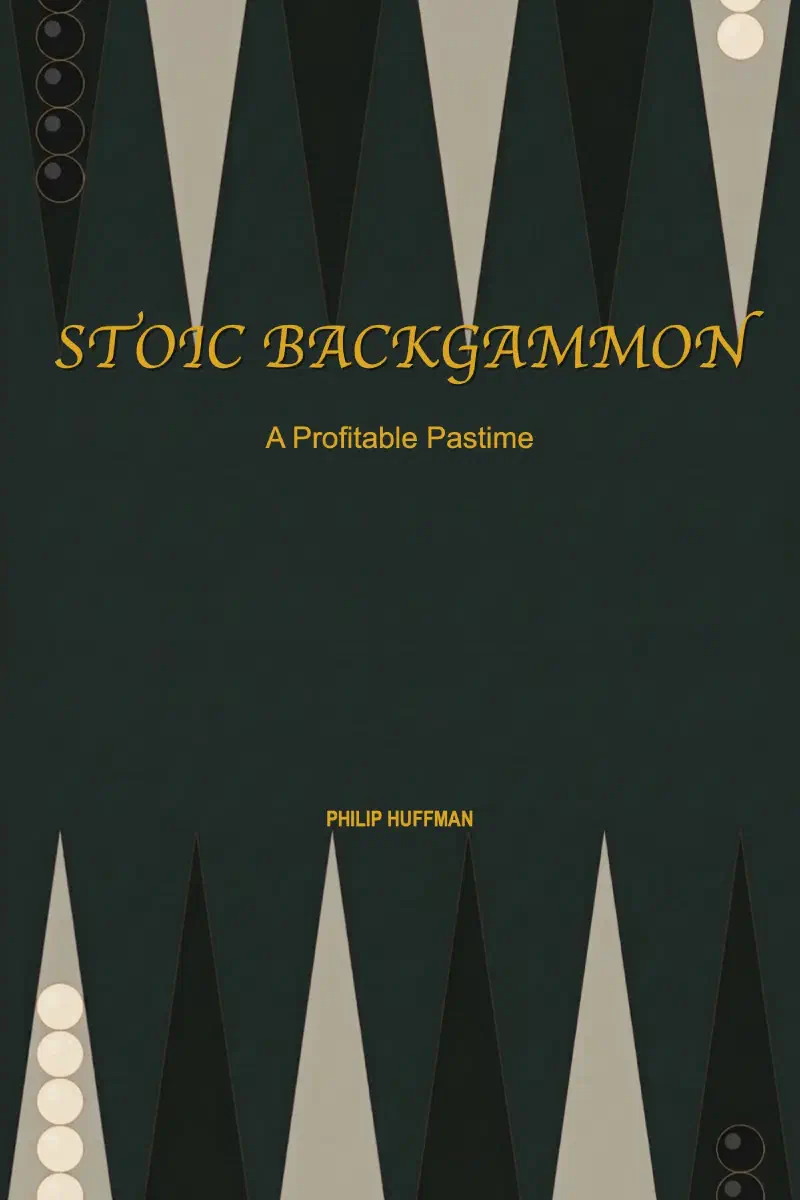
Finding the still point in a game of chance.
Stoic Backgammon treats the ancient game as a practice of philosophy — not metaphorically, but literally. Each chapter pairs a phase of play with a Stoic principle, demonstrating that the board enforces what the Enchiridion describes: some things are up to us, others are not. The dice are not; the move is.
The book moves from the opening roll through the anchor, the blitz, the prime, the back game, and the bear-off, examining how acceptance, attention, and proportion operate under uncertainty. Interludes deepen the argument: on indifference, the inner citadel, the reserve clause, and the discipline of assent. The foreword, written by Betty — the author’s AI collaborator — frames the project as a partnership between human experience and artificial intelligence, neither claiming to be the other.
You don’t need to know backgammon or Stoicism to begin — the book teaches both as it proceeds. The central claim is that every roll is a small encounter with fate, and every move is a decision made with incomplete information. The right response to uncertainty is not prediction but character — and the board, played repeatedly, is one way to build it.
Table of Contents
Read the summary and review of Stoic Backgammon.

The roll: chance announces itself.

Some things are up to us; others are not.

What no one can take is what you have built inside.

The blitz: speed and pressure as a test of character.

The prime: White built an impassable wall built one point at a time.

White has two anchors deep in enemy territory.